Which mid-size 6DOF motion platform fits your payload?
The six models split into three chassis tiers. The 500, 800 and 1000 kg models share a 300 mm stroke and a 160 x 140 x 102 cm parked body. The 1500 and 1800 kg models share a 600 mm stroke and a 301 x 285 x 170 cm body. The 2500 kg model stands alone at 341 x 310 x 185 cm.
Crossing a tier boundary changes more than the badge on the chassis. Actuator stroke doubles from 300 mm to 600 mm, and single-axis heave widens from about 0.17 to 0.19 m to 0.40 m. The footprint grows with it, so a tier change is a room-planning decision as much as a mechanical one.
A practical order of operations works better than starting from weight. First fix the chassis tier using the motion envelope your scenario needs and the floor area you have. Then, inside that tier, choose between models on payload capacity and moment of inertia. The step from the 1000 kg model to the 1500 kg model crosses a tier boundary, so it is a step in motion envelope, not only in capacity.
Mid-size 6DOF motion platform specifications compared
The table below collects the published figures for all six models in one place. Every value is taken from the corresponding product page, and each model name links to that page so you can check the full specification sheet before you shortlist.
|
sMOTION500-E6D |
sMOTION800-E6D |
sMOTION1000-E6D |
sMOTION1500-E6D |
sMOTION1800-E6D |
sMOTION2500-E6D |
| Product code |
SM500-300-C01-E6D |
SM800-300-C01-E6D |
SM1000-300-C01-E6D |
SM1500-600-C01-E6D |
SM1800-600-C01-E6D |
SM2500-600-C01-EP6D |
| Payload |
500 kg |
800 kg |
1000 kg |
1500 kg |
1800 kg |
2500 kg |
| Actuator stroke |
300 mm |
300 mm |
300 mm |
600 mm |
600 mm |
600 mm |
| Moment of inertia (X, Y, Z) |
250 kg·m² |
450 kg·m² |
550 kg·m² |
1200 kg·m² |
2000 kg·m² |
4000 kg·m² |
| Parked dimensions (L x W x H) |
160 x 140 x 102 cm |
160 x 140 x 102 cm |
160 x 140 x 102 cm |
301 x 285 x 170 cm |
301 x 285 x 170 cm |
341 x 310 x 185 cm |
| Heave, single axis |
-0.17 / 0.16 m |
-0.19 / 0.18 m |
-0.17 / 0.16 m |
-0.40 / 0.35 m |
-0.40 / 0.35 m |
-0.40 / 0.35 m |
| Roll, single axis |
±21.00° |
±21.00° |
±22.40° |
±20.60° |
±20.60° |
±20.60° |
| Pitch, single axis |
-22.00 / 22.00° |
-20.00 / 22.00° |
-22.30 / 23.40° |
-20.20 / 21.10° |
-20.20 / 21.10° |
-20.20 / 21.20° |
| Yaw, single axis |
±26.00° |
±22.00° |
±33.50° |
±24.00° |
±24.00° |
±24.00° |
| Yaw, multi axis |
±30.00° |
±26.00° |
±43.00° |
±26.56° |
±26.56° |
±26.56° |
| Surge / sway velocity |
±0.55 m/s |
±0.55 m/s |
±0.56 m/s |
±0.80 m/s |
±0.81 m/s |
±0.80 m/s |
| Heave velocity |
±0.45 m/s |
±0.40 m/s |
±0.51 m/s |
±0.75 m/s |
±0.64 m/s |
±0.70 m/s |
| Yaw velocity |
50°/s |
45°/s |
55°/s |
60°/s |
45°/s |
55°/s |
| Power supply |
380VAC ±10%, 3ph, 50/60 Hz |
380VAC ±10%, 3ph, 50/60 Hz |
380VAC ±10%, 3ph, 50/60 Hz |
380VAC ±10%, 3ph, 50/60 Hz |
380VAC ±10%, 3ph, 50/60 Hz |
380VAC ±10%, 3ph, 50/60 Hz |
Why payload capacity alone does not size a platform
Payload capacity tells you how much mass the platform is rated to carry. What loads the actuators during motion is how that mass is distributed: the height of the centre of gravity above the platform surface, and how far the mass sits from the axis of rotation. Two 1000 kg rigs can place very different demands on the same machine.
The mechanics are simple leverage. A display head carried on a 1 m arm has four times the moment of inertia of the same head at 0.5 m, because inertia grows with the square of the distance, and that inertia has to be accelerated and reversed on every cycle of the scenario. A cabin’s centre of gravity also rarely lands exactly over the platform centre, which leaves a standing roll and pitch moment the actuators hold continuously rather than only at the excursion limits. The effect of centre-of-gravity height on actuator force in a Stewart platform is treated in detail in Li’s work on modeling and control of a Stewart platform.
This is why payload is published next to moment of inertia on each of the six mid-size product pages: 250, 450, 550, 1200, 2000 and 4000 kg·m² across the class. When you request a quote, send the cabin or rig weight, the centre-of-gravity height and the mass distribution. The model is selected against those three numbers, not against weight by itself.
Floor space, parked height and installation planning
Parked dimensions for the three tiers are 160 x 140 x 102 cm, 301 x 285 x 170 cm and 341 x 310 x 185 cm. Required ceiling height is not the parked height: add the upward heave excursion, then the height of your cabin or rig, then service clearance above it.
Worked as a method rather than a single number: for the sMOTION2500-E6D you start at 185 cm parked height, add 0.35 m of upward heave, then add the height of the cabin sitting on the interface and the clearance your maintenance team needs overhead. The same arithmetic on the compact tier starts at 102 cm and adds 0.16 to 0.18 m of heave depending on the model. Run it with your own cabin dimensions before you commit a bay.
Electrical supply is the same across the class at 380VAC ±10%, three phase, 50/60 Hz. Send your bay dimensions and ceiling clearance with your enquiry, and the installation figures for the specific model, including platform weight and power consumption, are discussed as part of the quote.
Integrating a full-scale cabin, cockpit or mockup
The 500 to 2500 kg band is the full-scale band. These are the platforms selected to carry an instrumented cabin, an operational turret, a complete cockpit or a vehicle body, rather than a seat and a frame. A full-scale cabin on a Stewart platform normally lands somewhere in this class.
Control integration is common to all six models: UDP-based communication with the host PC, IMU-based motion feedback, and a graphical user interface for setup and manual operation. Your simulation software drives the platform from its own scenario over the UDP link, so the motion comes from the same model that generates the visuals.
Two integration patterns in this class have their own pages worth reading alongside this one: the driver-in-the-loop simulator for vehicle validation work, and flight simulators for cockpit and flight training devices.
Certification: who qualifies the training device?
A motion platform is a component of a training device, not a certified device in itself. The party that qualifies a flight simulation training device with an authority is the integrator who builds and presents the complete device, using the platform documentation as part of that submission.
What the rules ask of the motion system depends on the device and its level. Where EASA CS-FSTD(A) calls for a motion system, it sets a minimum of three degrees of freedom in pitch, roll and heave and asks for cues at least equivalent to those of a six-degree-of-freedom synergistic platform. The highest full flight simulator levels call for a six degrees of freedom motion system.
Mid-size SANLAB platforms are six-axis synergistic hexapods. If your project is heading for qualification, platform documentation and the data your submission needs are discussed as part of the quote.
Defense and test-bench applications in the 500-2500 kg range
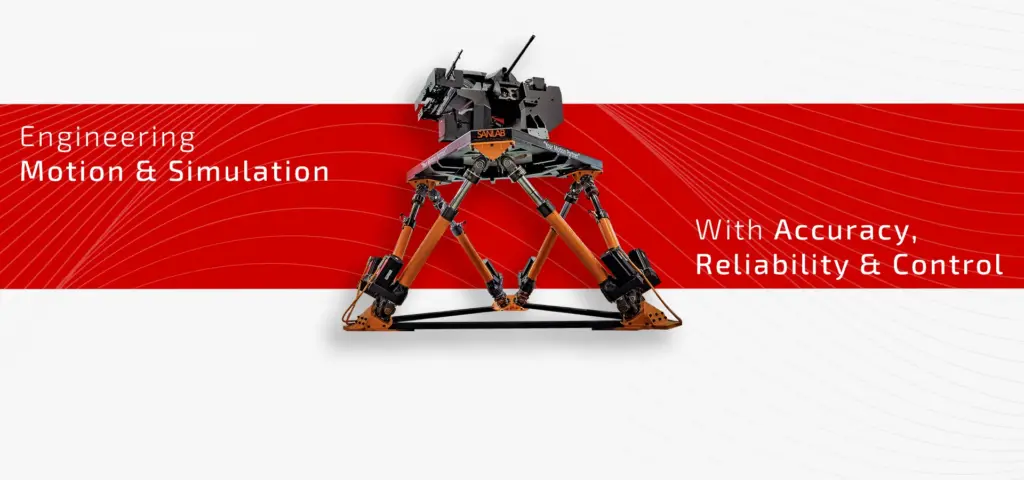
In defense and test work this class is used as a moving bench for remote control weapon systems testing, camera tracking systems testing, electro-optical systems testing, radar testing, rotator testing, antenna testing and turret systems testing. The same platforms also run stabilization testing and vehicle, driving, flight and mockup simulators.
A moving bench does one thing well: it produces a repeatable carrier motion in the laboratory. The platform reproduces the disturbance a vehicle, ship or aircraft would impose on the mounted system, and the line-of-sight stabilization or tracking performance of that system is then measured under the same motion profile run after run. Because the profile is commanded rather than captured in the field, two design iterations can be compared against identical input. The control problem for electro-optical tracking on a moving base is described in the open literature, including this study of line-of-sight stabilization on a moving platform.
For the wider sector context, see defense applications and testing and simulation applications.
Outdoor and harsh-environment use (IP66 option)
Every model in the mid-size class is available with an IP66 outdoor option, so the platform can be specified for dust and water exposure from the start of the project.
In practice IP66 matters when the platform lives where the test lives. Dust ingress and water jets are what a platform on a proving ground, a quayside or an open test range actually meets. If your installation is outdoors or in a wash-down area, say so with your enquiry so the outdoor option is quoted from the start.
When to choose the small or the large class instead
Below 200 kg the right starting point is the small 6DOF hexapod platforms, 50 to 200 kg, and above 2500 kg it is the large 6DOF motion platforms, 3,000 to 6,000 kg. Loads above 200 kg start in this class, with the sMOTION500-E6D as the entry point, and which mid-size model fits is settled by moment of inertia, centre-of-gravity height and the motion excursions your scenario needs, not by weight alone. Those class pages list the models in each band, so compare there before deciding.