


SANLAB designs and manufactures motion platforms, stabilizers and training simulators. The heavy class is our highest payload 6DOF range, with three models rated at 8,000 kg, 10,000 kg and 14,000 kg for defense, aerospace and test applications.
All three share a hexapod (Stewart platform) architecture driven by six electromechanical actuators, run on a 380VAC ±10%, 3-phase, 50/60 Hz supply, and are offered with an optional IP66 outdoor variant under a separate product code. Compare the three models below, or request a quote with your payload figures.
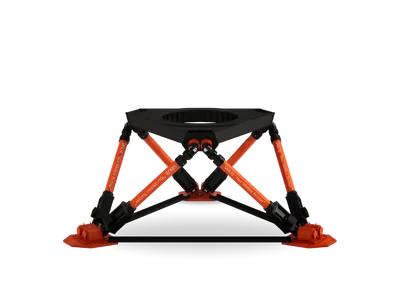
Match the model to the mass you need to move: sMOTION8000-E6D up to 8,000 kg, sMOTION10000-E6D up to 10,000 kg, sMOTION14000-E6D up to 14,000 kg. All three have identical body dimensions, so the selection follows payload and moment of inertia rather than available floor area.
The body envelope of every model in this class is 555 x 491 x 303 cm, so the same floor area is reserved whichever of the three you choose.
Between the 8,000 kg and 10,000 kg models, actuator stroke, dimensions and all dynamic figures are the same. The only differences are the payload rating and the moment of inertia, 15,000 kg.m² against 18,000 kg.m². If your structure is heavy for its size, that inertia figure is usually the deciding number, not the mass alone.
The 14,000 kg model is a separate step rather than a small increment: it carries more mass, uses a longer actuator stroke of 1,030 mm, and reaches higher surge, sway and heave velocities and higher angular accelerations.
The table below puts the three heavy class models side by side. Figures are as published on the individual product pages.
| sMOTION8000-E6D | sMOTION10000-E6D | sMOTION14000-E6D | |
|---|---|---|---|
| Product code | SM8000-1020-C01-EP6D | SM10000-1020-C01-EP6D | SM14000-1030-C01-EP6D |
| Payload | 8,000 kg | 10,000 kg | 14,000 kg |
| Actuators | 6 electromechanical | 6 electromechanical | 6 electromechanical |
| Actuator stroke | 1,020 mm | 1,020 mm | 1,030 mm |
| Dimensions (L x W x H) | 555 x 491 x 303 cm | 555 x 491 x 303 cm | 555 x 491 x 303 cm |
| Moment of inertia (X, Y, Z axes) | 15,000 kg.m² | 18,000 kg.m² | 22,000 kg.m² |
| Power supply | 380VAC ±10%, 3ph, 50/60Hz | 380VAC ±10%, 3ph, 50/60Hz | 380VAC ±10%, 3ph, 50/60Hz |
| Surge (velocity / acceleration) | ±0.60 m/s, ±6 m/s² | ±0.60 m/s, ±6 m/s² | ±0.70 m/s, ±7 m/s² |
| Sway (velocity / acceleration) | ±0.60 m/s, ±6 m/s² | ±0.60 m/s, ±6 m/s² | ±0.70 m/s, ±7 m/s² |
| Heave (velocity / acceleration) | ±0.50 m/s, ±8 m/s² | ±0.50 m/s, ±8 m/s² | ±0.60 m/s, ±8 m/s² |
| Roll (velocity / acceleration) | 23°/s, ±130°/s² | 23°/s, ±130°/s² | 23°/s, ±160°/s² |
| Pitch (velocity / acceleration) | 23°/s, ±130°/s² | 23°/s, ±130°/s² | 23°/s, ±160°/s² |
| Yaw (velocity / acceleration) | 25°/s, ±160°/s² | 25°/s, ±160°/s² | 26°/s, ±180°/s² |
| Outdoor variant code | SM8000-1020-C01-EP6DO | SM10000-1020-C01-EP6DO | SM14000-1030-C01-EP6DO |
| Ingress protection | IP66 on the outdoor variant | IP66 on the outdoor variant | IP66 on the outdoor variant |
| Outdoor operating temperature | -20 °C to +50 °C | -20 °C to +50 °C | -20 °C to +50 °C |
| Outdoor storage temperature | -30 °C to +60 °C | -30 °C to +60 °C | -30 °C to +60 °C |
For the smaller size classes, see all SANLAB 6DOF Stewart platforms.
Three inputs size a platform: the mass of the load, the height of its centre of gravity above the mounting surface, and its moment of inertia around each axis. As the centre of gravity rises, the moment each actuator has to carry grows, even though the mass has not changed.
In the heavy class the moment of inertia rating steps from 15,000 kg.m² on the 8,000 kg model to 18,000 kg.m² on the 10,000 kg model and 22,000 kg.m² on the 14,000 kg model. Treat the mass figure as the start of the conversation, not the end of it: request a quote with your mass, centre of gravity height and inertia figures, and ask us to confirm the model against them.
In this class, more capacity does not cost you dynamics. The sMOTION14000-E6D carries the heaviest load and also reaches the highest figures in the range: surge and sway at ±0.70 m/s and ±7 m/s², heave at ±0.60 m/s, roll and pitch acceleration at ±160°/s², yaw acceleration at ±180°/s².
The reason sits in the inertia column. Moment of inertia describes how mass is distributed around an axis of rotation, not simply how much there is. Two structures of equal mass behave differently if one is tall and wide and the other is compact: the spread out structure needs more torque to start rotating and more torque to stop. The inertia ratings of 15,000, 18,000 and 22,000 kg.m² tell you how much rotational load the drive system is designed to accelerate, not just hold.
That is why a bulky antenna assembly of 9,000 kg can need a larger model than a dense gearbox of the same mass. Six electromechanical actuators with real-time control and IMU-based motion feedback follow the commanded trajectory smoothly across the envelope, which is what repeatable test conditions depend on.
Every model in the heavy class runs on six electromechanical actuators and a 380VAC ±10%, 3-phase, 50/60 Hz supply. There is no hydraulic power unit, so the hydraulic plant room, the line runs, the manifold and the fluid temperature control that a hydraulic motion base needs are simply absent from the installation.
Practically, that shortens the civil and mechanical scope. You are preparing a foundation and an electrical feed rather than a foundation, an electrical feed, a pump room and a fluid circuit. There are no hoses or seals to inspect for leaks, no filter and fluid change intervals, and no drip containment to design into the test hall floor. For test labs sharing a building with optical or electronic equipment, removing pressurised fluid from the room removes a contamination path as well.
Installed power, standby consumption, room heat load and behaviour on loss of supply are configuration dependent, and we do not publish single figures for them. These are sized per project, so send us your duty cycle and ask for the figures that apply to your configuration.
All three heavy class models carry the same application list, because the difference between them is capacity rather than purpose. They are built for test rigs and large simulators where the article under test weighs several tonnes and has to be moved in six axes.
The common thread is repeatability. A field trial gives you real conditions but never the same conditions twice, which makes it hard to tell a design change from a weather change. On a motion platform you replay the same profile as many times as the test plan needs, change one variable at a time, and record against a known input. Sea state, road surface and terrain profiles can be run back to back in the same afternoon.
For a worked example, see turret and RCWS testing with a 6DOF motion platform, and for the wider picture our defense and military simulation applications and testing and simulation applications pages.
Full flight simulators at Level C and Level D require a six degree of freedom motion system; Level A and Level B can be met with three degrees of freedom. ICAO Doc 9625 Type VII is treated as equivalent to FAA Level D. A 6DOF platform is therefore the right class of motion system for that work.
It is worth being precise about roles. We supply the motion system as a component. Qualification is awarded to the complete training device, covering the flight model, the cueing, the visual system, the instructor station and the integration of all of it, so it is the integrator or operator of the finished device who holds that approval, not the supplier of any single subsystem. For that reason we do not describe these platforms as certified, qualified or compliant to a simulator level.
The qualification standards also set transport delay budgets across the motion, instrument and visual systems. We do not publish a latency figure for these platforms, so bring the delay budget from your own specification to the conversation and ask us what the control chain means for it.
Site planning for all three models starts from the same body envelope, 555 x 491 x 303 cm, and the same electrical feed, 380VAC ±10%, 3-phase, 50/60 Hz. Choosing a larger model in this class does not change the footprint you need to reserve.
Foundation, anchoring and floor loads are worked out project by project, because they depend on the model, the mass and centre of gravity of your payload and the motion profile you intend to run. Around the machine, reserve free space for the full motion envelope.
Ceiling height is the sum of three things, not one: the height of the platform itself, the height of whatever is mounted on top of it such as a cabin or test fixture, and the clearance consumed by heave and tilt at the extremes of travel.
Floor reaction loads, minimum ceiling height, lifting requirements and upper floor installation are project specific, and we do not publish general figures for them. Share your site drawing with us and ask us to check it against the model you are considering.
Each of the three heavy class models is offered with an IP66 protected outdoor variant as an option, ordered under its own product code: SM8000-1020-C01-EP6DO, SM10000-1020-C01-EP6DO and SM14000-1030-C01-EP6DO. Both codes are listed on the same product page.
IP66 protection covers dust ingress and high pressure water jets, which is what matters once the platform leaves a conditioned hall. Typical cases are a permanent open air test pad, a platform under a temporary shelter or tent, and a range installation where the article under test has to see real sky, real sun and real weather. Antenna, radar and electro-optical work often cannot be done any other way.
All three product pages publish the same environmental limits for the outdoor variant: an operating temperature range of -20 °C to +50 °C and a storage temperature range of -30 °C to +60 °C. The storage band is the one to check for shipping and for a site installation that stands unused through the winter. If your site runs colder, hotter or more humid than those limits, send us the site conditions with your enquiry.
If your payload is 6,000 kg or below, the right page is Large motion platforms from 3,000 to 6,000 kg. The heavy class starts at 8,000 kg; a load that falls between the two classes is matched to the next model up, the sMOTION8000-E6D.
Use the mass and inertia of the moving assembly, not the mass of the test article alone, when you decide which page applies. If your structure is unusually tall for its mass, send us both figures and ask which model applies.
The highest rating in the range is 14,000 kg, on the sMOTION14000-E6D, product code SM14000-1030-C01-EP6D. It uses six electromechanical actuators with 1,030 mm stroke and is rated for 22,000 kg.m² moment of inertia. The 8,000 kg and 10,000 kg models sit below it in the same class.
Payload and moment of inertia. The sMOTION8000-E6D is rated at 8,000 kg and 15,000 kg.m², the sMOTION10000-E6D at 10,000 kg and 18,000 kg.m². Actuator stroke (1,020 mm), body dimensions (555 x 491 x 303 cm), power supply and all velocity and acceleration figures are identical on the two models.
All three heavy class models are all-electric, driven by six electromechanical actuators on a 380VAC ±10%, 3-phase, 50/60 Hz supply. There is no hydraulic power unit, so the installation has no pump room, no pressurised lines, no manifold and no hydraulic fluid temperature control to design or maintain.
Yes. Each model has an optional IP66 outdoor variant with its own product code: SM8000-1020-C01-EP6DO, SM10000-1020-C01-EP6DO and SM14000-1030-C01-EP6DO. All three product pages publish an operating range of -20 °C to +50 °C and storage of -30 °C to +60 °C for the outdoor variant.
Four things move a quote forward quickly: payload mass, centre of gravity height above the mounting surface, moment of inertia around each axis, and the overall size of what you are mounting. Add the installation site and whether you need the indoor or IP66 outdoor variant.
Request a quote for a heavy duty motion platform. Tell us what you need to move and ask which of the three models fits your case. Sending the figures below with your enquiry usually removes a full round of questions.
Request a quote with those details and ask our engineering team to go through the selection with you.