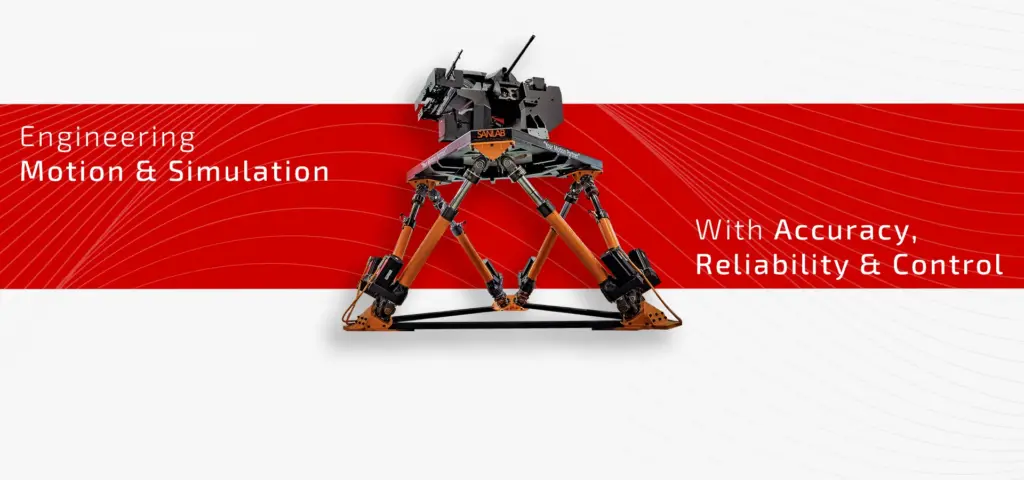

The small class consists of three 6DOF hexapod platforms, built on the Stewart architecture, rated at 50, 100 and 200 kg of payload. All three run on six electro-mechanical actuators with 200 mm of stroke, share a 108 x 96 x 58 cm body and run from a 220VAC supply. The main difference between them is the mass they carry and the moment of inertia that mass produces.
SANLAB manufactures the sMOTION 6DOF family, 18 models covering payloads from 50 kg up to 14,000 kg. This page covers the three smallest of them. Typical work for this class: sensor, gimbal, radar and antenna stabilization testing, and single-seat simulation rigs.
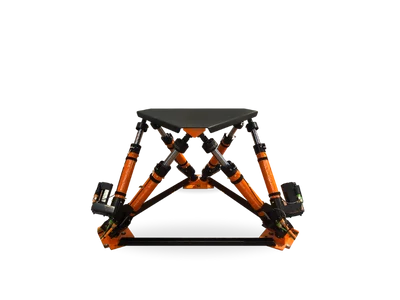
Size the platform in three steps: the weight of the load, the height of its center of gravity together with how its mass is distributed, and the angular dynamics you want to reproduce. All three models occupy the same floor area and reach the same angular excursions, so the choice sits almost entirely on the load side.
The entry point of the class, rated at 50 kg. It suits light sensor heads, small gimbals and compact test fixtures, and it is the practical choice when the load is modest but you still need all six axes. Specifications are listed on the sMOTION50-E6D product page.
Rated at 100 kg, this is the mid-range option for test loads that have outgrown the 50 kg model but stay well inside the class. It carries the same stroke and footprint, so stepping up from 50 kg is a payload decision, not a facility decision. See the sMOTION100-E6D product page.
At 200 kg this is the upper limit of the small class, and it is the only one of the three whose product page lists driving simulators and flight simulators among its applications. Full specifications are on the sMOTION200-E6D product page.
Within the figures compared below, payload and moment of inertia are what change. Model code aside, stroke, dimensions, power supply, surge and sway velocity and acceleration, and the roll, pitch and yaw excursions are identical. Angular rates and heave figures are listed per model on each product page.
| Specification | sMOTION50-E6D | sMOTION100-E6D | sMOTION200-E6D |
|---|---|---|---|
| Model code | SM50-200-C01-E6D | SM100-200-C01-E6D | SM200-200-C01-E6D |
| Payload | 50 kg | 100 kg | 200 kg |
| Actuator stroke | 200 mm | 200 mm | 200 mm |
| Dimensions | 108 x 96 x 58 cm | 108 x 96 x 58 cm | 108 x 96 x 58 cm |
| Power supply | 220VAC ±10%, 50/60 Hz | 220VAC ±10%, 50/60 Hz | 220VAC ±10%, 50/60 Hz |
| Moment of inertia (X, Y, Z) | 23 kg·m² | 45 kg·m² | 92 kg·m² |
| Surge / sway velocity | ±0.50 m/s | ±0.50 m/s | ±0.50 m/s |
| Surge / sway acceleration | ±5 m/s² | ±5 m/s² | ±5 m/s² |
| Roll excursion (single / multi axis) | ±23.00° / ±28.30° | ±23.00° / ±28.30° | ±23.00° / ±28.30° |
| Yaw excursion (single / multi axis) | ±28.80° / ±32.10° | ±28.80° / ±32.10° | ±28.80° / ±32.10° |
| Pitch excursion (single axis) | -22.50° / 23.80° | -22.50° / 23.80° | -22.50° / 23.80° |
| Pitch excursion (multi axis) | -30.10° / 30.90° | -30.10° / 30.90° | -30.10° / 30.90° |
| Actuators | 6 electro-mechanical | 6 electro-mechanical | 6 electro-mechanical |
Excursions are given separately for single axis and multi axis motion because in a parallel architecture, moving one axis consumes travel that the other axes would otherwise have available.
Weight alone does not size a hexapod. What matters is how that mass is distributed around the rotation axes, which is why each model publishes a moment of inertia figure: 23 kg·m² for the 50 kg model, 45 kg·m² for the 100 kg model and 92 kg·m² for the 200 kg model.
The practical consequence is that a tall, narrow rig can pass the weight limit and still exceed the inertia limit. A 90 kg mast carrying a sensor head at the top loads the actuators very differently from a 90 kg block sitting flat on the upper plate. Send the center of gravity height and the overall dimensions of the load along with its weight when you request a quote, so the model can be checked against both limits.
Static and dynamic payload are explained in general terms on the 6DOF motion platforms from 50 to 14,000 kg page.
Yes, within the limits of the class. The sMOTION200-E6D product page lists flight and driving simulators among its applications, and 200 kg of payload with 200 mm of stroke corresponds to a single-seat cockpit rig. SANLAB’s ready-built SM200 Flight Simulator carries the same 200 kg payload and 200 mm stroke figures, and its product page lists DCS (Digital Combat Simulator) and Prepar3D integration.
The regulatory boundary is worth stating plainly. A full flight simulator qualified under 14 CFR Part 60 in the United States or EASA CS-FSTD(A) in Europe is a replica of a specific aircraft type, and the highest qualification levels call for a six degrees of freedom motion system. The place of this class is research rigs, single-seat training devices and engineering trials.
All three product pages list the same core applications: camera tracking systems, electro-optical systems, radar, rotator, antenna and stabilization testing. With 200 mm of stroke and roll excursions of ±23.00° on a single axis, the platform reproduces realistic motion disturbance under the unit being tested.
That is the right tool when you need to replay the motion a vehicle, mast or ship deck actually imposes on a payload, in the laboratory. The parallel architecture gives a hexapod its precise, consistent motion, so the same disturbance profile can be replayed run after run and every unit under test sees the same conditions.
Six axes are the point here. Real disturbance arrives on several axes at once, so a system that moves in only one or two axes leaves part of the problem untested. See also defense applications and testing and simulation applications.
Facility planning is the same for all three models. Each one measures 108 x 96 x 58 cm and runs from a 220VAC ±10%, 50/60 Hz supply, so moving from 50 kg to 200 kg does not change your floor plan or your electrical work.
Ceiling height is the dimension you do need to calculate yourself. Required height is the height of the platform itself, plus the heave travel, plus the height of the structure mounted on the upper plate, plus the vertical sweep the tilt excursions produce at the top of that structure.
For deployment outside a laboratory, IP66 protection is offered as an outdoor option across the 6DOF models, ordered under a separate product code. In this class the outdoor variants are SM50-200-C01-E6DO, SM100-200-C01-E6DO and SM200-200-C01-E6DO, each with an operating temperature range of -20 °C to +50 °C, a storage range of -30 °C to +60 °C and the same motion performance as the standard model. Tell us the installation site, indoor or outdoor, when you send your specifications, so the correct product code is quoted.
The three models share the same control hardware, so integration work does not change with payload rating. The platform is driven from your computer over a standard network link and reports its motion back in real time.
Move up when the load exceeds 200 kg, and also when the load stays under 200 kg but its mass distribution pushes the moment of inertia past 92 kg·m². A tall or wide fixture can reach that point at a comfortable weight. The medium motion platforms class starts at 500 kg, and the full range is listed under 6DOF motion platforms from 50 to 14,000 kg.
Three capacities: 50 kg with the sMOTION50-E6D, 100 kg with the sMOTION100-E6D and 200 kg with the sMOTION200-E6D. All three use six electro-mechanical actuators with 200 mm of stroke and share the same body dimensions, so payload and moment of inertia are the main figures that separate them.
The hexapod Stewart design produces full six axis motion, surge, sway, heave, roll, pitch and yaw, from a very compact footprint. Six actuators share the load in parallel rather than stacking one axis on another, which keeps the structure stiff and the moving mass low for its payload rating. That stiffness is the basis of the precise, consistent motion research and simulation work depends on.
The product pages for all three models list camera tracking systems, electro-optical systems, radar, rotator, antenna and stabilization testing. Stroke and angular excursions are identical across the class, so the models differ in the payload they can carry, not in the travel they offer. The sMOTION200-E6D page lists driving simulators and flight simulators among its applications.
Yes, through the outdoor variants. IP66 protection is available as an option across the 6DOF models, ordered under a separate product code. All three small models have an outdoor variant, SM50-200-C01-E6DO, SM100-200-C01-E6DO and SM200-200-C01-E6DO, rated for -20 °C to +50 °C in operation and -30 °C to +60 °C in storage.
Weight alone does not answer that. A tall, narrow load produces a high moment of inertia around the horizontal axes, and the sMOTION100-E6D is rated at 45 kg·m². Send the weight, the center of gravity height and the overall dimensions, and the 100 and 200 kg models can be checked against both limits.
Yes. The sMOTION200-E6D product page lists flight simulators among its applications, and 200 kg of payload with 200 mm of stroke covers a single-seat cockpit rig. The SM200 Flight Simulator is the ready-built version. A qualified full flight simulator under 14 CFR Part 60 or EASA CS-FSTD(A) is a different category of device.
Yes. The sMOTION50-E6D, sMOTION100-E6D and sMOTION200-E6D all measure 108 x 96 x 58 cm and run from 220VAC ±10%, 50/60 Hz. Only ceiling height changes between projects, because that depends on the structure you mount on the upper plate, not on the platform model.
Over UDP based computer communication. The control hardware is common to all three models and provides real-time control, a user friendly graphical interface and IMU based motion feedback. Commands reach the platform from your own computer over a standard network link, and the same setup applies whichever payload rating you choose.
Sizing a platform starts from the load. Useful information to include:
Request a quote with those details.