


SANLAB develops industry leading motion platforms designed for high fidelity simulation, professional testing, and research applications. Our range of systems, including 6DOF (Stewart Platforms), 3DOF, and 2DOF configurations, provides precise and dynamic movement across various payload scales. Whether for defense R&D, automotive testing, or immersive training, our motion systems deliver uncompromising accuracy and real time response.
SANLAB manufactures motion platforms, also called motion bases or motion systems, in three families: 2DOF, 3DOF and 6DOF. Our 6DOF platforms use the Stewart platform architecture, widely known as a hexapod. A 6DOF platform moves a payload on all three translations and all three rotations. A 3DOF platform gives heave, roll and pitch. A 2DOF platform tilts and rotates on two axes under high load. Across the three families our published payload classes run from 50 kg to 25,000 kg, so the same selection logic applies to a small trainer cabin and to a heavy test structure. The comparison table below shows which family fits your task.
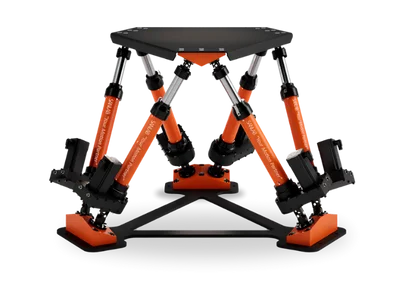
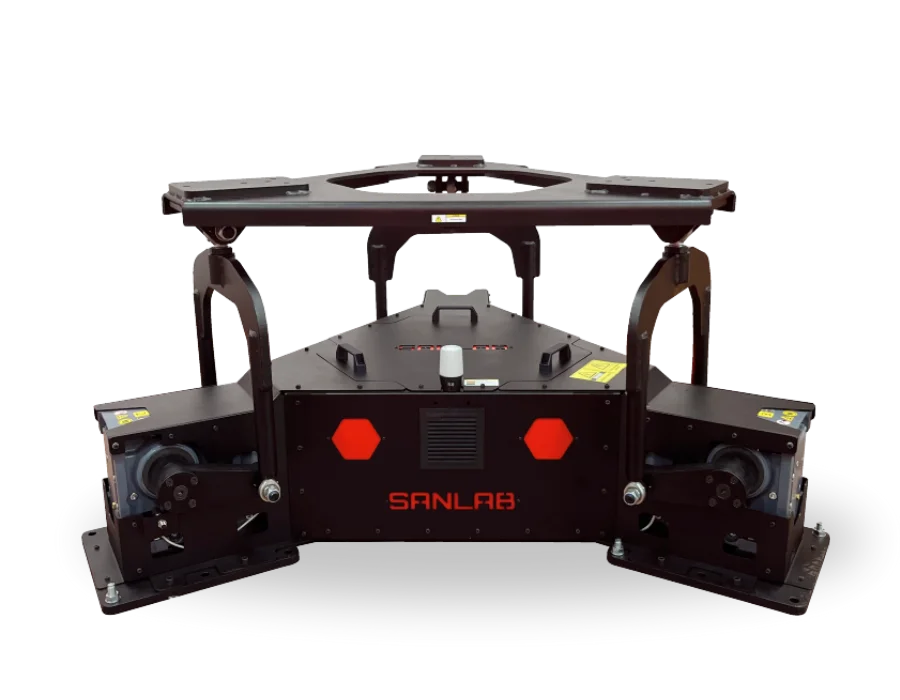
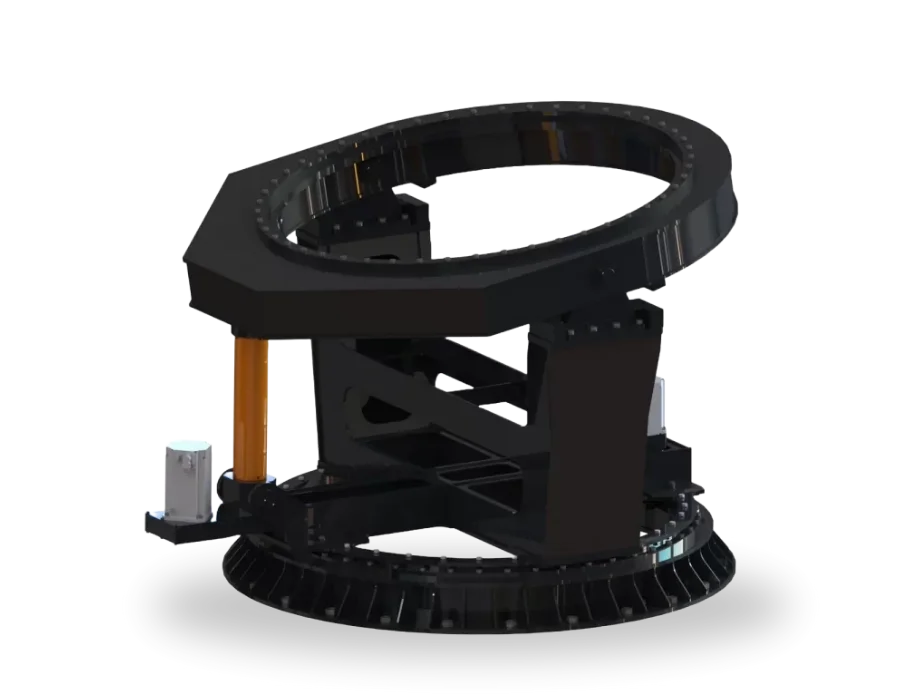
Every SANLAB motion system is a product of advanced robotics and precision engineering. Our platforms utilize high performance electro mechanical actuators, which provide superior accuracy compared to traditional hydraulic systems.
Payload Versatility: From lightweight testing at 50 kg to heavy duty industrial loads of 25,000 kg.
Real Time Integration: Seamlessly syncs with simulation software for immediate physical feedback.
Durable Design: Engineered for longevity in harsh testing and training environments.
Customized Solutions: Ability to tailor stroke, velocity, and payload specs to unique project requirements.
A motion platform is a system that moves the load mounted on it along defined axes. A degree of freedom is one axis that the system controls independently. Six degrees of freedom cover three translations, surge, sway and heave, and three rotations, roll, pitch and yaw.
Surge is movement forward and back, sway is movement left and right, and heave is movement up and down. Roll, pitch and yaw are the rotations around those same three lines. A platform family is defined by which of these axes it controls, not by how many actuators it carries. For the full breakdown of the axes, read six degrees of freedom explained.
Choose the axis count from the physical motion cues your task actually needs, because the highest axis count is not the right answer for every job. 6DOF gives full freedom of movement, 3DOF gives vertical movement plus tilt on two axes, and 2DOF gives precise tilt and rotation under high load.
| Family | Axes SANLAB provides | What the motion gives you | Typical tasks on our pages | Payload range | Page |
|---|---|---|---|---|---|
| 6DOF (Stewart architecture / hexapod) | surge, sway, heave, roll, pitch, yaw | all three translations and all three rotations | defense and tactical simulation, weapon testing, automotive R&D, industrial simulation, film and special effects | 50 kg to 14,000 kg | 6DOF motion platforms with Stewart architecture |
| 3DOF | heave, roll, pitch | vertical movement plus tilt on two axes: pitch for acceleration and braking, roll for cornering, heave for road irregularities | land vehicle and military simulators, electro-optic, radar and turret system validation, driver training | 500 kg to 1,000 kg | 3DOF motion platforms: heave, roll and pitch |
| 2DOF | pitch and roll, or XY axis control (tilt and rotate) | precise two axis tilt under high load | tank test and training simulators, prototype evaluation, structural testing | 250 kg to 25,000 kg | 2DOF tilt and rotate platforms up to 25,000 kg |
The axes column is the one to read first. The definition of 3DOF is not consistent across the market: some manufacturers define 3DOF as pitch, roll and yaw, which is three rotations and no vertical travel. Our 3DOF motion platforms: heave, roll and pitch include heave, so the platform reproduces vertical movement and road irregularities, not tilt alone. If you are comparing offers, ask each supplier which three axes are included. Two platforms carrying the same DOF number can deliver different motion. The 3DOF family covers 500 kg to 1,000 kg, with models including sMOTION500-E3D and sMOTION1000-E3D.
For full six axis motion, the detail sits on the subpage: 6DOF motion platforms with Stewart architecture covers the size categories and the payload classes in that family. Where the task is heavy tilting and rotation rather than full freedom of movement, 2DOF tilt and rotate platforms up to 25,000 kg carry the highest payload we publish.
No. Axis count alone does not determine platform quality. The quality of the motion cues the system produces, the stroke available on each axis, the acceleration at rated load and the latency from signal to movement all matter. A set of axes matched to the task beats an extra axis nobody uses.
When you compare platforms, compare these items for the same cabin: stroke on each axis, acceleration at rated load, frequency response, latency from signal to motion, and the mass and center of gravity of the cabin you intend to mount. The figures that change with the model, such as actuator stroke, velocity and acceleration per axis, are given on the individual product pages rather than as family wide values.
Research supports this. A study of a 3DOF driving simulator combined with a VR headset reports that a suitable motion cueing algorithm reduced the conflict between visual and vestibular input. A lower axis count works when the cueing is built correctly for the task.
When a specific qualification target is in scope, axis count stops being a preference and becomes an entry condition. For the highest level of flight simulator qualification, the motion system is expected to produce acceleration in all six degrees of freedom, and the acceleration onset cueing principle with a Stewart platform architecture is the de facto standard for that purpose.
Level D full flight simulator qualification and the Type VII device described in ICAO Doc 9625 are defined by what the device must reproduce, not by a supplier claim. Qualification of the finished simulator is a process between the program owner and the competent authority. See our 6DOF motion platforms with Stewart architecture and our flight simulators.
Match the axis set to what the task has to reproduce, then check the payload class. Defense work and heavy test rigs sit at the top of the load range, vehicle validation needs vertical movement with pitch and roll, and marine stabilization is a separate product family with a much lower payload.
Five pieces of information are enough to point you to the right family: the total moving mass including the cabin and everything in it, the center of gravity, the axes you need, the installation footprint and ceiling height, and the simulation software or interface the platform has to connect to.
Send us the payload, the axes you need and the installation space, and we will point you to the right platform family. Request a quote.
A motion platform, also called a motion base or a motion system, moves the load mounted on it along defined axes. Actuators drive the platform surface under real time control, so the cabin follows the motion commands produced by the simulation.
6DOF covers all three translations and all three rotations, with payload classes from 50 kg to 14,000 kg. 3DOF covers heave, roll and pitch, from 500 kg to 1,000 kg. 2DOF tilts and rotates on two axes, from 250 kg to 25,000 kg. The comparison table above sets the three families side by side.
A 6DOF platform controls surge, sway, heave, roll, pitch and yaw. Our 3DOF platforms control heave, roll and pitch, giving vertical movement plus tilt on two axes, without yaw or lateral travel. Some manufacturers define 3DOF differently, so confirm which three axes are included.
Yes. Customization is defined per project rather than as a fixed option list. To scope it we need the total payload including the cabin and its contents, the center of gravity, the axes required, the installation space and the interface to your simulation software.
No. Axis count is one factor among several. Stroke per axis, acceleration at rated load, frequency response, latency from signal to motion and the quality of the motion cueing determine what the operator feels. A 3DOF platform with correct cueing can outperform a six axis platform poorly matched to the task.
They are two names for the same parallel architecture. A Stewart platform uses six actuators between a fixed base and a moving upper plate, which gives control of all six axes. Hexapod is the common market term for that layout. Our 6DOF platforms use this architecture.
For the highest qualification levels, in practice yes. Level D full flight simulator qualification expects the motion system to produce acceleration in all six degrees of freedom, which is why the Stewart platform architecture is the de facto standard. Qualification of the finished device rests with the program owner and the competent authority.
Five items: total payload including the cabin and everything mounted in it, the center of gravity, the axes you need, the installation footprint and ceiling height, and the simulation software or signal interface. Send these through the quote form and we will point you to the right family.
Tell us what the platform has to move and where it will be installed, and we will point you to the family that fits. Request a quote with your payload, required axes and installation space.