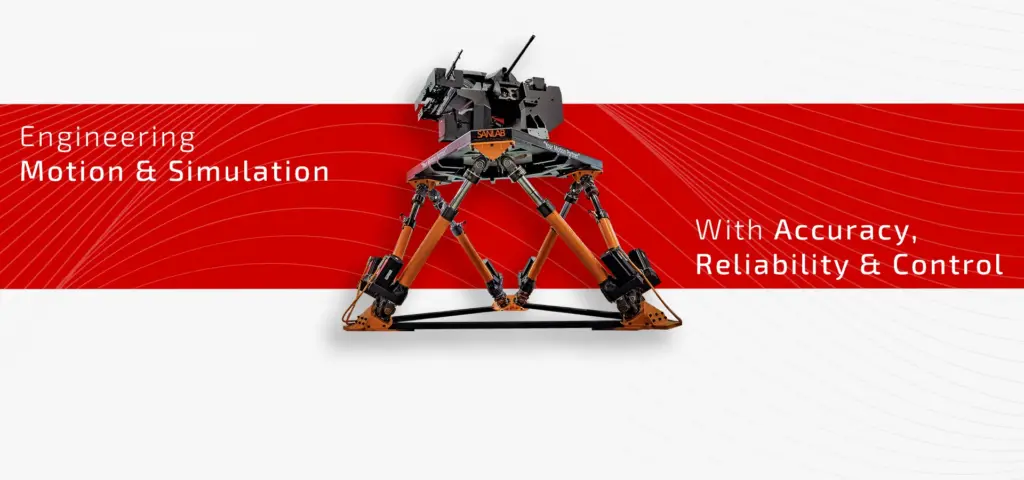

SANLAB designs and manufactures its own motion platforms, stabilized platforms and training simulators. Our gyro stabilized platforms provide 2DOF stabilization in roll and pitch for payloads from 20 kg to 300 kg, across three product lines: the Heavy Payload Stabilizer series (SS150 and SS300), the Satellite Stabilizer and the UAV Landing Stabilizer.
This page is built for model selection. Below the product cards you will find a specification table taken from the published product data, guidance on how to read excursion, velocity and acceleration figures, and the marine qualification details buyers ask about most often. The cards link to the full specification page for each model, and the closing section links to the Request a quote form, where you can state payload mass, center of gravity offset, required compensation angle and operating environment.
High performance maritime operations require precision that constant wave motion often disrupts. Roll and pitch movements directly impact the accuracy of optical systems, satellite links, and defense sensors. SANLAB stabilized platforms counter these dynamic forces with real time responsiveness, ensuring that critical equipment stays level and operational regardless of sea states. From offshore platforms to mobile naval systems, our stabilizers provide the structural integrity and motion compensation needed to protect high value payloads ranging from 20 kg to 300 kg and maintain continuous signal connectivity in the most demanding environments.


A gyro stabilized platform is a motorized base that isolates a payload from the motion of its carrier. Inertial sensors measure roll and pitch, and the control system drives the actuators in the opposite direction, so the mounted antenna, radar or landing pad stays level while the vessel or vehicle moves underneath it.
One term needs care, because it is used for two different machines. In the leisure and commercial marine market, “gyro stabilizer” usually means a flywheel unit installed inside a hull to reduce the roll of the boat itself. SANLAB stabilized platforms do not stabilize the vessel. They stabilize what sits on top of it, which is why their specifications are written in payload mass, compensation angle and angular velocity rather than in vessel displacement. If your requirement is a steadier deck for the crew, you are looking for the first type of product. If your requirement is a sensor, antenna or pad that holds its attitude while the deck moves, you are looking for the second.
Match the model to payload mass and the compensation angle your application needs. The Heavy Payload Stabilizer series carries high payload and high inertia systems in two sizes, 150 kg (SS150) and 300 kg (SS300); the SS150 is published with ±30° excursion. The Satellite Stabilizer covers 20 to 100 kg antenna and communication payloads. The UAV Landing Stabilizer covers 20 to 100 kg drone landing and optical payloads.
| Heavy Payload Stabilizer SS150 | Satellite Stabilizer | UAV Landing Stabilizer | |
|---|---|---|---|
| Payload | 150 kg | 20-100 kg (customizable) | 20-100 kg (customizable) |
| DOF | 2DOF, roll and pitch | 2DOF, roll and pitch | 2DOF, roll and pitch |
| Excursion (roll / pitch) | ±30° | ±15° | ±15° |
| Velocity | Roll ±50°/s, pitch ±30°/s | ±10°/s | ±10°/s |
| Acceleration | ±280°/s² | ±20°/s² | ±20°/s² |
| Actuator stroke | 300 mm | Not published | Not published |
| Moment of inertia | 90 kg·m² | Not published | Not published |
| Dimensions | L 136 x W 136 x H 77 cm | Not published | Not published |
| Power supply | 400VAC ±10%, 50/60Hz | Not published | Not published |
| Actuator type | Linear actuator | Not published | Not published |
| Operating temperature | -10 °C to +50 °C | Not published | Not published |
| Protection class | IP66 | IP66 | IP66 |
| Standards | Military test specs of MIL-STD810 | Military test specs of MIL-STD810 | Military test specs of MIL-STD810 |
Cells marked “Not published” are values we do not publish on the product page for that model. Please ask for them in your quote request, stating the project they apply to, rather than reading them as zero or as a missing capability.
The Heavy Payload Stabilizer series also includes the SS300 for payloads up to 300 kg. Its data sheet is available in the SS300 catalogue.
Full data per model: Heavy Payload Stabilizer SS150 specifications, Satellite Stabilizer for LEO antenna alignment and UAV Landing Stabilizer specifications.
Excursion is the maximum tilt the platform can compensate, velocity is how fast it can follow that tilt, and acceleration is how quickly it can reverse direction when the motion changes. Read the three together: an adequate angle at insufficient velocity still lags behind a steep, fast sea state.
Take the SS150 as the worked example. Its published figures are ±30° excursion and ±280°/s² acceleration in roll and pitch, ±50°/s velocity in roll and ±30°/s in pitch, with a 300 mm linear actuator stroke. The angle tells you the sea state or vehicle attitude it can absorb. The velocity tells you that it can track that angle at speed instead of arriving late. The acceleration figure is the one buyers skip most often, and it is the one that decides behaviour in short period, confused seas, where the deck reverses direction before the platform has finished the previous correction. The stroke figure matters for installation, since it sets the vertical envelope the platform needs under the payload. These four numbers belong to the SS150 and should not be read across to the other models, whose published values are listed in the table above.
Moment of inertia describes how the payload mass is distributed around the rotation axes. The same mass mounted higher, or offset from the center, adds load the actuators must overcome. The SS150 product page publishes 90 kg·m², and that figure is as binding a limit as the 150 kg payload rating.
The practical consequence is that payload mass alone does not tell us whether a model fits. A 120 kg radar mounted low and centred is a different mechanical problem from a 120 kg mast assembly whose mass sits half a metre above the interface plate. Accurate roll and pitch control depends on the actuators having authority over the real inertia they see, so give us four things in your quote request: payload mass, overall height, center of gravity offset from the rotation axes, and the mounting interface you plan to use. With those, model selection is a calculation rather than an estimate.
A 2DOF platform compensates roll and pitch, the two rotations that tilt a payload off level. It does not compensate yaw rotation or heave, the vertical rise and fall of the carrier. Those axes stay with the vessel, so azimuth pointing remains the payload’s own job.
Framed axis by axis, a six axis body has three rotations (roll, pitch, yaw) and three translations (surge, sway, heave). Roll and pitch are the two that break line of sight for an antenna or tip a landing surface out of plane, which is why every SANLAB stabilizer is specified in those axes. Yaw is usually handled inside the payload itself, by the antenna’s own azimuth drive or the sensor’s pan axis, so duplicating it in the base adds mass without adding capability. Heave moves the payload up and down but keeps it level, so it affects range geometry rather than attitude. If your requirement is motion generation across all six axes for test and simulation work, that is the 6DOF motion platform side of our range, and for tilt and rotate test rigs see our 2DOF motion platforms for tilt and rotate testing.
At sea, holding antenna alignment is the limiting factor on low earth orbit links, because the terminal has to track a moving satellite from a moving deck. The Satellite Stabilizer is designed for exactly this task: it actively compensates pitch and roll motion to maintain continuous antenna alignment, and its product page states Starlink compatibility.
Whether a given antenna needs mechanical stabilization depends on the system architecture around it. Some terminals compensate electronically within their own beam steering budget and tolerate moderate vessel motion. Others, and particularly higher gain apertures with narrow beamwidth, lose link margin as soon as the deck angle exceeds their tolerance. The same logic applies beyond communications: radar returns and electro-optical imagery both degrade when the mount wanders, and sensor fusion across several payloads is easier when they share one stable reference plane. The honest answer is that the decision belongs to your link budget and your payload’s own specification. The Satellite Stabilizer page lists its published figures, including IP66 protection and Military Test Specs of MIL-STD810, so you can check them against that budget.
Moving the compensation to the pad rather than the aircraft widens the landing window. The UAV Landing Stabilizer is published as a 2DOF landing and positioning base for drone and optical payloads, 20 to 100 kg (customizable), with ±15° excursion, ±10°/s velocity and ±20°/s² acceleration in roll and pitch.
The reason this helps is that a rotary wing aircraft approaching a pitching deck has to solve two problems at once: its own attitude control and a touchdown surface that is not where it was a second ago. Levelling the surface removes the second problem, which can shorten the approach and reduce the number of waved off attempts. Three deployment scenarios come up repeatedly. First, a ship or offshore platform helideck or drone pad, where roll and pitch dominate. Second, a moving land vehicle, where the pad has to stay level over uneven ground. Third, an unmanned surface vessel acting as a forward launch and recovery node, where no crew is available to assist a difficult landing. For a 2DOF stabilized platform shown with an unmanned surface vessel, see the 2DOF stabilized platform shown with ULAQ KAMA.
These measure different things. An IP class states ingress protection against dust and water. MIL-STD-810 is not a single test but a library of methods, for example salt fog (Method 509) and rain (Method 506). One does not substitute for the other, so check both, and check them per model.
Here is what our pages publish. IP66 protection applies across the SANLAB stabilizer range. All three models are also published with Military Test Specs of MIL-STD810, and the SS150 is rated for an operating temperature range of -10 °C to +50 °C.
Buyers of commercial marine equipment often ask for two further things: compliance with IEC/EN 60945 for shipborne equipment, and type approval from a classification society. These are separate exercises from an IP class or a MIL-STD-810 method, with their own documentation. State the standard your project requires in your quote request, with the applicable methods and severities, so the requirement can be assessed against the specific model you have in mind.
On marine and offshore platforms, on defence vehicles and systems, and under antenna, radar, electro-optical and RCWS payloads, drone landing pads and aerospace stabilization systems. The published application lists differ by model, so check the product page for the payload type you plan to mount.
By model, the SS150 page lists aerospace stabilization systems, drone landing pads, electro-optical systems, RCWS, radar systems and antenna systems. The Satellite Stabilizer page lists satellite and communication equipment, radar and sensor stabilization platforms, antenna systems, defence and security systems, and marine and mobile platform stabilization. The UAV Landing Stabilizer page lists UAV and drone landing pad stabilization, radar systems, electro-optical systems, defence and security systems, and marine and mobile platform stabilization.
Integration features are also published per model, not per family. The SS150 page lists IMU-integrated stabilization, joystick control, UDP based PC communication, a user-friendly GUI, real-time control and modular design. The Satellite Stabilizer page lists IMU-integrated stabilization and real-time control among its features. The UAV Landing Stabilizer page lists modular design and compatibility with multiple payload types. For the vessel and offshore context, see our marine roll and pitch stabilization applications.
SANLAB stabilized platforms utilize high-speed sensors and Inertial Measurement Units (IMU) to detect wave induced roll and pitch in milliseconds. Our proprietary Control Systems then drive precision actuators to counteract these movements, keeping the top payload perfectly level with the horizon. This level of responsiveness is vital for maintaining the signal integrity of satellite antennas and the safety of UAV operations.
In a marine environment, the most disruptive forces for directional equipment are roll and pitch. While a 3DOF system adds heave, most stabilized platforms for antennas and landing pads prioritize compensating for angular tilts to maintain line of sight with satellites or drones. This 2DOF approach offers a more compact and efficient design without compromising the payload's safety or accuracy.
Yes, our Satellite Stabilizer is specifically designed for antenna alignment with Low Earth Orbit (LEO) constellations like Starlink. By compensating for continuous sea motion and vibration, it ensures the antenna remains locked on the satellite, preventing connection drops and maintaining maximum data throughput during offshore transits.
Every SANLAB stabilizer is engineered with IP66-rated enclosures and built using rugged, corrosion resistant materials to withstand heavy seas, saltwater spray, and high humidity. Our systems incorporate advanced protective coatings and vibration damping technology to ensure reliable operation and precise alignment across multi domain applications. Whether deployed on small yachts or large offshore industrial platforms, these stabilizers maintain signal integrity and structural durability where performance cannot be compromised.
Across the range, from 20 kg to 300 kg. The Heavy Payload Stabilizer series covers 150 kg (SS150) and 300 kg (SS300), the Satellite Stabilizer 20 to 100 kg (customizable) and the UAV Landing Stabilizer 20 to 100 kg (customizable). Mass is not the only limit: height and center of gravity offset affect the usable capacity, so include both in your enquiry.
No. A boat gyro stabilizer is a flywheel unit fitted inside the hull to reduce the roll of the vessel itself. A gyro stabilized platform is a motorized base that keeps the payload on top of it level while the vessel moves. SANLAB stabilized platforms are the second type, specified in payload mass and compensation angle.
A stabilizer removes motion, holding the payload steady against the movement of its carrier. A motion platform produces motion, driving a payload through controlled angles for test, simulation and training. The two use related mechanics for opposite purposes. For the motion generation side, see our 2DOF motion platforms for tilt and rotate testing.
The Satellite Stabilizer and UAV Landing Stabilizer pages both list marine and mobile platform stabilization among their published applications. The SS150 page does not list it, so check the application list of the model you have in mind. Each case is assessed per project, because mounting interface, power supply, vibration input and environmental exposure vary. Send your platform details with the payload data and the installation can be reviewed against a specific model.
Model selection comes down to four inputs: payload mass, center of gravity offset, the compensation angle your application needs, and the environment the platform will work in. Send those four inputs through the Request a quote form, stating the payload and the environment, so model selection can be assessed against your project. Companies interested in representing SANLAB in their market can use the Become a Distributor page.