


SANLAB designs and manufactures six degree of freedom motion platforms, stabilized platforms and training simulators. The Large class is the high payload 6DOF motion platform range: six models rated from 3,000 kg to 6,000 kg of payload, built for test articles and full scale mockups that are too heavy for a general purpose simulator platform.
Every model in the class runs on six electromechanical actuators in a parallel kinematic layout, the hexapod or Stewart platform configuration, and is supplied from 380VAC ±10%, 3-phase, 50/60 Hz. An IP66 outdoor option is available on every model. Below the model cards you will find how to choose between them, a full specification table and the site requirements for installation.
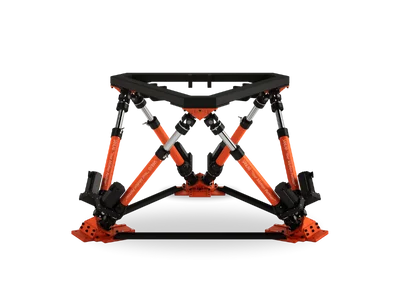
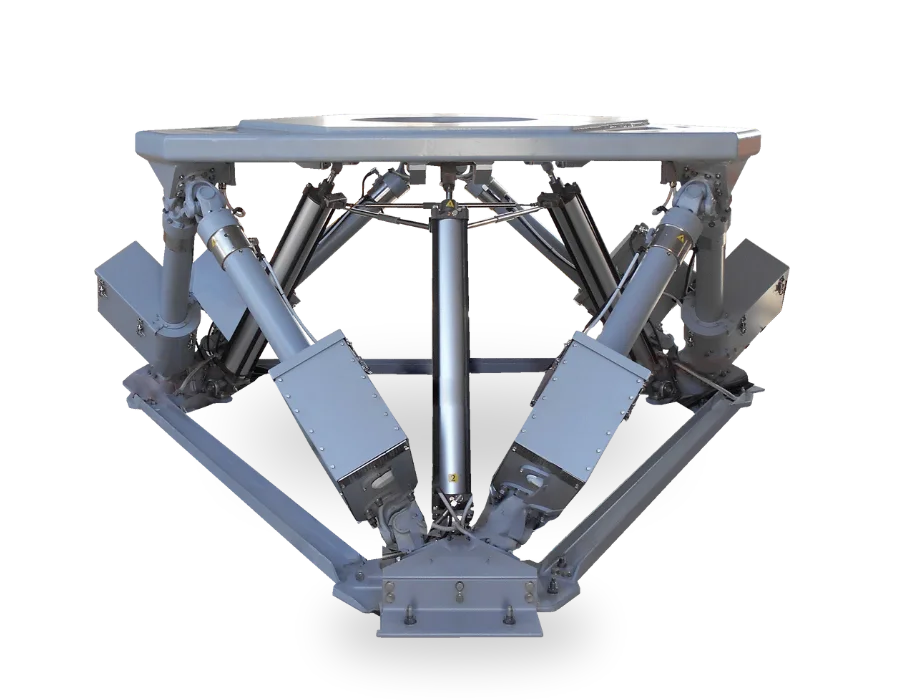
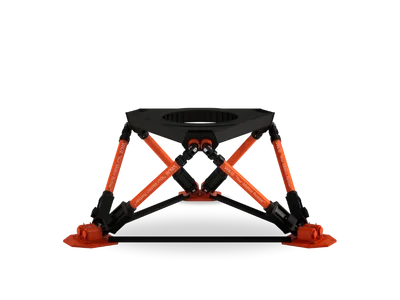
Start with payload, then check actuator stroke and floor footprint before you commit to a model. The six Large platforms fall into four frame sizes: a compact 3,000 kg frame, a 3,200 kg outdoor frame with 700 mm stroke, a shared mid frame covering 3,500 to 5,000 kg, and a 6,000 kg frame with 1,020 mm stroke.
Compact frame. sMOTION3000-E6D, the most compact platform in the class, has 600 mm of actuator stroke in a 301 x 285 x 170 cm envelope. This is the smallest footprint in the Large class, so it is the model to look at first when available floor area, not mass, is the binding constraint.
Outdoor frame. sMOTION3200-EP6DO, the outdoor model with 700 mm stroke, measures 341 x 310 x 185 cm. It carries the longest stroke in the class after the 6,000 kg model, and it is engineered for outdoor use. It also reaches the highest roll and pitch rates in the class at 50°/s each.
Mid frame. sMOTION3500-E6D, sMOTION4000-E6D and sMOTION5000-E6D share one frame: 600 mm stroke, 324 x 296 x 182 cm. What separates them is payload, moment of inertia and peak rates, and those do not scale evenly. The 3,500 kg model runs surge and sway at ±0.80 m/s with 45°/s roll and 52°/s yaw, the highest yaw rate in the class. The 4,000 kg model drops to ±0.70 m/s with 40°/s roll and pitch, and the 5,000 kg model sits at ±0.75 m/s with the same 40°/s. Moment of inertia steps up from 5,000 kg.m² on the 3,500 kg model to 5,650 kg.m² on the other two. Identical outside dimensions do not mean an identical motion envelope, so size against the rate you actually need to reproduce.
Large frame. sMOTION6000-E6D, with 1,020 mm actuator stroke, is a different machine: 555 x 491 x 303 cm and 10,000 kg.m² of inertia. Its stroke is roughly 1.7 times the 600 mm stroke of the compact and mid frames, which is what you need when the application calls for long heave travel rather than fast angular motion. Its angular rates are correspondingly lower, at 30°/s roll and pitch.
All six Large models share the same drive concept and the same supply, and differ in payload, stroke, footprint, inertia and peak rates. The table below collects the figures published on the individual product pages so you can compare them in one place before writing a specification.
| sMOTION3000-E6D | sMOTION3200-EP6DO | sMOTION3500-E6D | sMOTION4000-E6D | sMOTION5000-E6D | sMOTION6000-E6D | |
|---|---|---|---|---|---|---|
| Payload capacity | 3,000 kg | 3,200 kg | 3,500 kg | 4,000 kg | 5,000 kg | 6,000 kg |
| Product code | SM3000-600-C01-EP6D | SM3200-700-C01-EP6DO | SM3500-600-C01-EP6D | SM4000-600-C01-EP6D | SM5000-600-C01-EP6D | SM6000-1020-C01-EP6D |
| Actuator stroke | 600 mm | 700 mm | 600 mm | 600 mm | 600 mm | 1,020 mm |
| Platform dimensions (L x W x H) | 301 x 285 x 170 cm | 341 x 310 x 185 cm | 324 x 296 x 182 cm | 324 x 296 x 182 cm | 324 x 296 x 182 cm | 555 x 491 x 303 cm |
| Moment of inertia (X, Y, Z) | 5,000 kg.m² | 5,000 kg.m² | 5,000 kg.m² | 5,650 kg.m² | 5,650 kg.m² | 10,000 kg.m² |
| Power supply | 380VAC ±10%, 3ph, 50/60Hz | 380VAC ±10%, 3ph, 50/60Hz | 380VAC ±10%, 3ph, 50/60Hz | 380VAC ±10%, 3ph, 50/60Hz | 380VAC ±10%, 3ph, 50/60Hz | 380VAC ±10%, 3ph, 50/60Hz |
| Surge / sway velocity | ±0.80 m/s | ±0.80 m/s | ±0.80 m/s | ±0.70 m/s | ±0.75 m/s | ±0.75 m/s |
| Surge / sway acceleration | ±7 m/s² | ±7 m/s² | ±7 m/s² | ±7 m/s² | ±7 m/s² | ±7 m/s² |
| Heave velocity | ±0.65 m/s | ±0.70 m/s | ±0.60 m/s | ±0.56 m/s | ±0.62 m/s | ±0.63 m/s |
| Heave acceleration | ±9 m/s² | ±10 m/s² | ±9 m/s² | ±7 m/s² | ±7 m/s² | ±9 m/s² |
| Roll velocity | 38°/s | 50°/s | 45°/s | 40°/s | 40°/s | 30°/s |
| Pitch velocity | 38°/s | 50°/s | 47°/s | 40°/s | 40°/s | 30°/s |
| Yaw velocity | 43°/s | 50°/s | 52°/s | 50°/s | 50°/s | 35°/s |
| Roll / pitch acceleration | ±220°/s² | ±200°/s² | ±200°/s² | ±200°/s² | ±200°/s² | ±160°/s² |
| Yaw acceleration | ±400°/s² | ±300°/s² | ±300°/s² | ±300°/s² | ±300°/s² | ±200°/s² |
Single axis and multi axis excursion limits are listed separately on each model page, because the travel available on one axis depends on how much of the envelope the other axes are using. Open the product page of the model you are considering, or see how 6DOF motion platforms are sized and named for the convention behind the codes.
Three inputs size a platform: the mass of the load, the height of its center of gravity above the mounting surface, and its moment of inertia about each axis. The geometry of what you bolt to the top frame matters as much as its weight.
Moment of inertia across the Large class comes in three steps: 5,000 kg.m² on the 3,000, 3,200 and 3,500 kg models, 5,650 kg.m² on the 4,000 and 5,000 kg models, and 10,000 kg.m² on the 6,000 kg model. That is why a tall cockpit mockup can call for a larger model than a compact turret of the same mass. The actuators do not see the mass alone, they see the inertia and the overturning moment at every change of direction, and both grow with center of gravity height.
Send the following with your enquiry and a model can be matched to the load rather than to the headline number:
Request a quote for your payload with those figures attached.
The meaningful difference is stroke and angular rate, not the 200 kg of payload. The sMOTION3200-EP6DO has 700 mm of actuator stroke against 600 mm, reaches 50°/s on roll and pitch against 38°/s, and is engineered for outdoor use. The sMOTION3000-E6D has the smallest footprint in the class at 301 x 285 x 170 cm.
If the platform goes into a hall with limited floor area and the load is compact, take the 3,000 kg model. If the motion profile needs more vertical travel and faster tilt, take the 3,200 kg model.
A real turret, remote control weapon station or electro-optical system is mounted on the platform in the laboratory, and the platform reproduces vehicle motion in six axes underneath it. Broken ground conditions that cannot be repeated twice on a proving ground become a repeatable, logged input, run as often as the test plan requires.
The product pages in this class list these test applications:
For a delivered example, see turret and RCWS testing for ASELSAN, and for the wider picture see motion systems for defense applications.
The same six models are used outside the test laboratory, for full scale cockpit mockups, flight and driving simulators and vehicle subsystem work. The deciding factor is the same in both cases: the load is a real structure with real mass distribution, not a lightweight cabin built to suit the platform.
In the Large class this covers full scale cockpit mockups and multi user installations, vehicle dynamics testing, and structural response testing where a subsystem is excited through its mounting points and the response is measured. In automotive durability work, large six axis tables of this kind are known in the industry as multi-axial simulation tables, or MAST, and the drive signal is usually derived from road load data acquisition on a proving ground, then replayed in the laboratory. That is the industry term and the usual workflow, quoted here so you can place the equipment, not as a statement about any particular standard.
See vehicle dynamics and automotive validation and system testing and simulation applications for how these installations are put together.
All six Large models are electromechanical. Each platform is driven by six electromechanical actuators, so there is no hydraulic power unit, no hydraulic oil, no oil conditioning and no oil change schedule in the maintenance plan. Supply is 380VAC ±10%, 3-phase, 50/60 Hz on every model in the class.
For the user this changes what the installation looks like. There is no power pack to find floor space for, no return line routing and no oil containment to design into the test cell. Control is real time and electromechanical throughout, which is what makes an axis profile repeatable run after run, so a test can be replayed under the same conditions weeks later.
Installation planning starts with three numbers: the footprint and height of the platform itself, the height of the load that sits on top of it, and the electrical supply at the site. Everything else, including anchoring, follows from the specific model and the specific payload.
Footprint and height. The most compact model in the class occupies 301 x 285 x 170 cm and the largest 555 x 491 x 303 cm. For ceiling height, add four figures: the static height of the platform, the height of the load above the mounting interface, the upward heave travel of the model you choose, and clearance for the tilt envelope, since a tall load swings a long way at the top when the platform rolls or pitches. Work that sum with your own load dimensions before fixing the room.
Power. All six models are supplied from 380VAC ±10%, 3-phase, 50/60 Hz.
Outdoor installation. An IP66 outdoor option is available on every 6DOF model. Tell us at enquiry stage whether the platform will be installed outdoors so the outdoor option is included in the quote.
Floor and anchoring. Floor load capacity and anchor detail are determined project by project, because they depend on the platform model, the mass and center of gravity of your payload and the motion profile you intend to run. Send the load data and the site drawing with your request a quote for your payload and these are worked out together rather than estimated in advance.
The Medium class covers 500 to 2,500 kg, the Large class 3,000 to 6,000 kg and the Heavy class 8,000 to 14,000 kg. If your load falls between two classes, size it against the next model up.
Below this class, medium motion platforms from 500 to 2,500 kg offer six models. Above it, heavy motion platforms from 8,000 to 14,000 kg cover 8,000, 10,000 and 14,000 kg.
Two things are worth checking before you settle on a model at the edge of a class. First, mockup and cabin mass commonly grows during a project as instrumentation, fixtures and ballast are added, so specifying a platform with no margin above today’s figure is a risk; consider the next model up instead. Second, when moment of inertia rather than mass is the dominant term, a load that looks comfortable on paper can push you into the next class earlier than its weight suggests. The structure of the whole range is explained in how 6DOF motion platforms are sized and named.
The Large class covers 3,000 kg to 6,000 kg of payload across six models: sMOTION3000-E6D, sMOTION3200-EP6DO, sMOTION3500-E6D, sMOTION4000-E6D, sMOTION5000-E6D and sMOTION6000-E6D. Loads up to 2,500 kg fall in the Medium class, and from 8,000 kg upward the Heavy class covers 8,000, 10,000 and 14,000 kg.
Not automatically. Payload capacity tells you the mass the platform carries, while the platform is sized by mass together with center of gravity height and moment of inertia about each axis. A tall load at 4,000 kg can demand the 5,000 or 6,000 kg model. Specifying at the limit also leaves no margin for mass growth during the project.
Stroke and angular rate. The sMOTION3000-E6D has 600 mm of actuator stroke and the smallest footprint in the class, 301 x 285 x 170 cm. The sMOTION3200-EP6DO has 700 mm of stroke, measures 341 x 310 x 185 cm, reaches 50°/s on roll and pitch, and is engineered for outdoor use.
Electric. Every model in the class is driven by six electromechanical actuators, so there is no hydraulic power unit, no hydraulic oil and no oil maintenance. Each platform is supplied from 380VAC ±10%, 3-phase, 50/60 Hz.
Yes. An IP66 outdoor option is available on every 6DOF model. Tell us at enquiry stage whether the platform will be installed outdoors so the outdoor option is included in the quote.
The load mass including fixtures, the center of gravity height above the mounting interface, the moment of inertia about each axis, the stroke and angular travel you need, the target frequency band, your usable floor area and ceiling height, whether the installation is indoor or outdoor, and a mounting interface drawing.
Send three things to get a model recommendation for your application: the mass, center of gravity height and moment of inertia of your load; the stroke, angular travel and frequency band you need to reproduce; and the floor area, ceiling height and supply available at your site. Request a quote for your payload and a model from the 3,000 to 6,000 kg range will be matched to those figures.