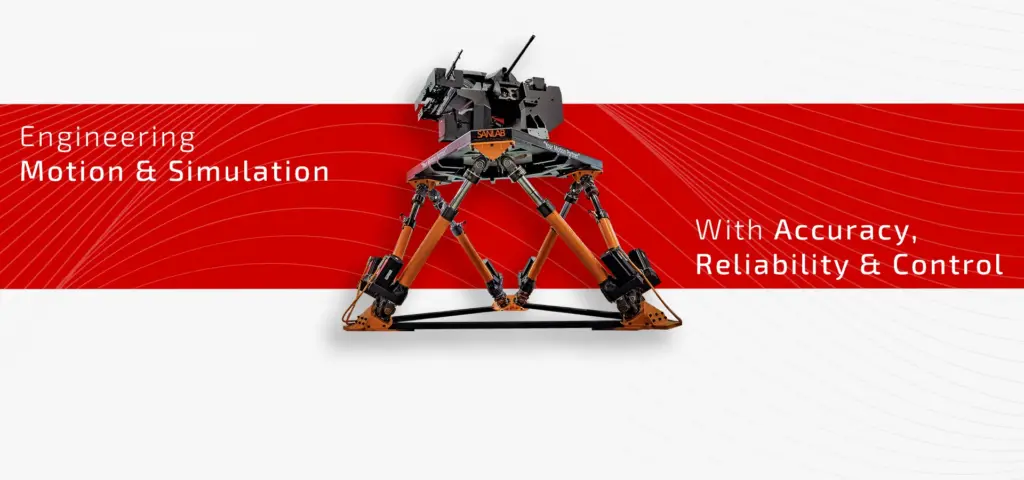

SANLAB manufactures six-axis electro-mechanical motion platforms. The 6DOF family covers payloads from 50 kg to 14,000 kg across 18 standard models, grouped into four size classes: small, medium, large and heavy. Each platform is built around six linear actuators in a parallel arrangement that moves the mounted load in three linear and three rotational axes. IP66 protection is available as an option across the range.
"6DOF motion platform", "Stewart platform" and "hexapod" are three names for the same machine: the parallel architecture chosen wherever motion has to be precise in all six axes at once. SANLAB builds it for simulation and testing loads from 50 kg to 14 tonnes, with precise, consistent motion control from the smallest platform to the heaviest. Pick your class from the cards below. The sections underneath explain how payload, stroke, axis travel, footprint and power supply decide which class fits your load.
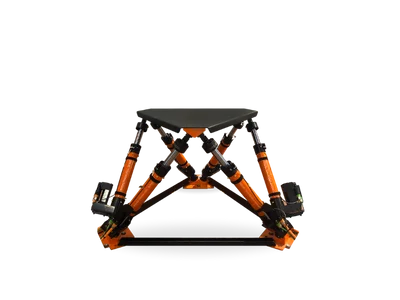
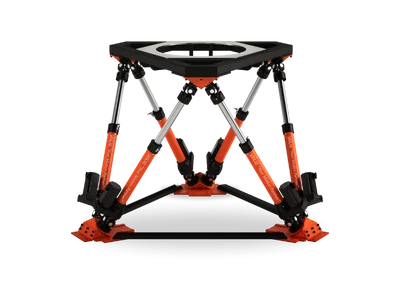
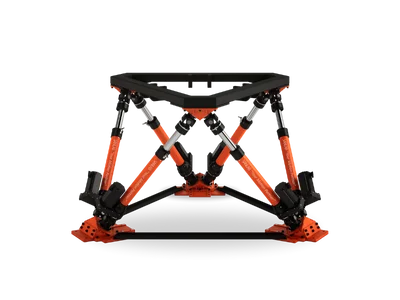
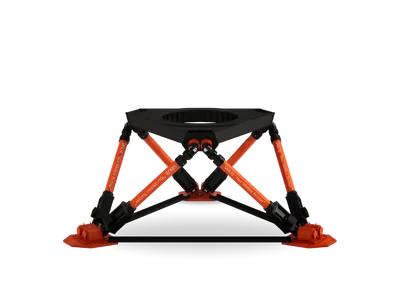
Yes, all three names describe the same machine: six linear actuators connected in parallel between a fixed base and a moving upper platform. The arrangement moves the platform in three linear axes (surge, sway, heave) and three rotational axes (roll, pitch, yaw), which is where the term 6DOF comes from.
The names come from the recorded history of the design. V. E. Gough built a parallel six-actuator tire-testing rig in 1954, Klaus Cappel developed a six-axis motion simulator in 1962, and D. Stewart published “A Platform with Six Degrees of Freedom” in 1965. The literature credits all three, which is why “Gough-Stewart platform” is also in common use. “Hexapod” refers to the six legs, “motion base” is the simulator industry’s term, and “parallel kinematic machine” is the term used in machine-tool work.
What matters when you buy is the application, not the name. The same architecture positions optics, semiconductor and synchrotron equipment at micron-level accuracy, and it drives full-scale simulators and test rigs. SANLAB builds it for both: precision positioning and testing, and motion simulation, for loads from 50 kg to 14 tonnes.
Each of the six legs is an electro-mechanical linear actuator, mounted to the base and to the upper platform through joints that let it pivot. A leg can only extend or retract along its own line, so no single actuator produces a single axis of motion. The controller does the conversion: for every pose you command, it calculates the six leg lengths that produce it, the inverse kinematics of the platform, and drives all six actuators together.
This is the main difference from a serial robot arm, where each joint moves the joints beyond it. In a Stewart platform all six legs work in parallel and share the payload, which keeps the structure stiff and lets a compact platform carry a heavy load. The trade-off is a bounded workspace: the axes are coupled, so travel in one axis depends on the position of the others. That is why SANLAB publishes travel separately for single-axis and multi-axis motion, and why continuous yaw rotation needs an added rotator or turntable.
For the background on serial and parallel mechanisms, see serial and parallel 6DoF explained.
Start with payload. The four classes cover 50 to 200 kg, 500 to 2,500 kg, 3,000 to 6,000 kg and 8,000 to 14,000 kg. In the example models below, actuator stroke grows with the class, footprint grows or stays the same, and published roll velocity drops in the larger classes. The smallest class that carries your load is usually the right place to start.
The classes map to models as follows:
| Size class | Example model | Payload | Actuator stroke | Heave range (multi-axis) | Max surge velocity | Roll velocity | Moment of inertia | Dimensions (L x W x H) | Power supply |
|---|---|---|---|---|---|---|---|---|---|
| Small | sMOTION200-E6D | 200 kg | 200 mm | -0.13 m to 0.12 m | ±0.50 m/s | 50°/s | 92 kg·m² | 108 x 96 x 58 cm | 220VAC ±10%, 50/60Hz |
| Medium | sMOTION2500-E6D | 2,500 kg | 600 mm | -0.40 m to 0.35 m | ±0.80 m/s | 50°/s | 4,000 kg·m² | 341 x 310 x 185 cm | 380VAC ±10%, 3ph, 50/60Hz |
| Large | sMOTION6000-E6D | 6,000 kg | 1,020 mm | -0.67 m to 0.61 m | ±0.75 m/s | 30°/s | 10,000 kg·m² | 555 x 491 x 303 cm | 380VAC ±10%, 3ph, 50/60Hz |
| Heavy | sMOTION14000-E6D | 14,000 kg | 1,030 mm | -0.64 m to 0.62 m | ±0.70 m/s | 23°/s | 22,000 kg·m² | 555 x 491 x 303 cm | 380VAC ±10%, 3ph, 50/60Hz |
Each class holds more than one model. The table shows one example from the upper end of each class; full values per model are on the product pages, such as the sMOTION2500-E6D specification table and the sMOTION14000-E6D specification table.
Read the roll velocity column before you size up. Published roll velocity falls from 50°/s on the sMOTION2500-E6D to 30°/s on the sMOTION6000-E6D and 23°/s on the sMOTION14000-E6D. A bigger platform is not automatically a better one: if your test or training profile depends on how fast the load moves rather than how heavy it is, oversizing costs you angular rate. Send us your payload and motion requirements through the quote form: request a quote.
Static payload is the weight the platform carries at rest. In service, the load also accelerates, and the inertial forces from that acceleration add to the static weight, so selection cannot be made on weight alone. How the mass is distributed matters as much as how much of it there is.
When you ask for a quote, send three things: the weight of the load, the height of its center of gravity above the platform surface, and its moment of inertia. If the moment of inertia is not known, the load geometry lets it be estimated.
Published moments of inertia show how much the distribution figure varies across the range: 92 kg·m² on the sMOTION200-E6D specification table, 4,000 kg·m² on the sMOTION2500-E6D, 10,000 kg·m² on the sMOTION6000-E6D specification table and 22,000 kg·m² on the sMOTION14000-E6D. A tall, narrow load and a flat, compact load of the same weight do not place the same demand on the actuators, which is why the inertia figure, not the weight alone, decides the selection.
Actuator stroke runs from 200 mm on the sMOTION200-E6D to 1,030 mm on the sMOTION14000-E6D. Travel per axis is published twice, once for single-axis motion and once for multi-axis motion, because the limit on any one axis changes when several axes are commanded at the same time.
The difference is worth understanding before you compare figures. Single-axis travel is what you get when only that axis moves. The two sets of figures are published separately and are not interchangeable: on the sMOTION200-E6D the multi-axis ranges are wider than the single-axis ranges, while on the sMOTION6000-E6D the heave range is the same in both columns, so when you compare two models, read the same column for both. On the sMOTION200-E6D, surge travel is -0.16 m to +0.18 m single-axis and -0.21 m to +0.20 m multi-axis. Yaw on the same model is ±28.80° single-axis and ±32.10° multi-axis.
Across the published models, angular travel sits in roughly the ±21° to ±32° band, with the single-axis figures at the lower end and the multi-axis figures at the upper end. Check the specification table of the model you are considering for the exact values.
One limit to be clear about: continuous 360° yaw is not possible on this architecture. The actuators have a finite stroke, so rotation is bounded on every axis. If your application needs unlimited rotation, that is a rotator or turntable requirement, not a Stewart platform requirement.
Footprint and electrical supply both change with the model. The sMOTION200-E6D runs on single-phase 220VAC and occupies roughly a square meter of floor, while the sMOTION6000-E6D and sMOTION14000-E6D need 380VAC three-phase and a base of about 5.5 by 4.9 meters. Both figures are published per model.
Verified examples: the sMOTION200-E6D measures 108 x 96 x 58 cm and runs on 220VAC ±10%, 50/60Hz. The sMOTION2500-E6D measures 341 x 310 x 185 cm and runs on 380VAC ±10%, 3-phase, 50/60Hz. The sMOTION6000-E6D and sMOTION14000-E6D both measure 555 x 491 x 303 cm on the same 380VAC ±10%, 3-phase, 50/60Hz supply.
Those dimensions are the platform body only. Above them you need clearance for the load you mount, for the motion envelope that load sweeps through, and for safe access around the machine, so the space a platform occupies in your building is larger than its base. Exact clearance depends on the load geometry and the motion profile, so the layout is worked out per project rather than taken from a general figure.
Every SANLAB 6DOF platform is electro-mechanically driven, with six electro-mechanical actuators in each model, from the sMOTION50-E6D to the sMOTION14000-E6D. In practice, electro-mechanical drive means no hydraulic power unit, no hose runs and no fluid to leak, which simplifies installation and maintenance indoors.
Hydraulic actuation holds a historical advantage in force density, which is why it dominated large motion bases for decades.
The choice is not decided by actuation type alone. Payload, stroke, duty cycle, ambient conditions and the volume of motion you need all feed into it, and the drive is specified once those are known.
SANLAB’s 6DOF platforms are used in defense systems testing, sensor and antenna testing, vehicle and flight simulators, stabilization testing and mockup simulators. Twelve application areas are published on the sMOTION2500-E6D, sMOTION6000-E6D and sMOTION14000-E6D product pages.
The small class carries a shorter list: weapon system and turret testing are not among its published applications, so check the product page for the model you are sizing.
For sector detail, see our defense applications and testing and simulation applications pages.
In test work, a hexapod platform is a positioning system. It puts a sensor, antenna, camera or electro-optical unit into a commanded pose, holds it there, or moves it through a motion profile that can be replayed run after run, so results from different tests stay comparable. Because the payload sits on six actuators working in parallel, the platform stays stiff under load, and all six axes are available at once instead of being stacked one stage on another.
SANLAB’s published test applications include remote control weapon systems, camera tracking, electro-optical, radar, antenna, rotator and turret systems testing, as well as stabilization testing. Compact sensor, gimbal and antenna work fits the small hexapod platforms, and heavier test articles move up through the medium, large and heavy classes. More examples are on the testing and simulation applications page.
For a positioning or test project, send:
Request a quote with these details and the configuration can be checked against your test plan.
A 6DOF motion platform, also known as a Stewart Platform or Hexapod, is a robotic system that provides movement in six degrees of freedom: three linear (surge, sway, heave) and three rotational (roll, pitch, yaw). These systems are essential for creating high-fidelity environments in professional simulation and testing.
Yes. Stewart platform, Gough-Stewart platform, hexapod and 6DOF motion platform all describe six linear actuators connected in parallel between a base and a moving platform. The names differ by industry, not by mechanism. The architecture is used wherever precise motion in all six axes matters, from micron-level positioning to full-scale simulation. SANLAB applies it to simulation and testing loads from 50 kg to 14 tonnes.
The controller converts the pose you command into six actuator lengths, one per leg, and drives all six actuators at once. Changing the leg lengths together translates the upper platform in surge, sway and heave and rotates it in roll, pitch and yaw. Because every move uses all six legs, the axes are coupled, which is why SANLAB publishes travel for both single-axis and multi-axis motion.
Every SANLAB 6DOF platform, from the sMOTION50-E6D to the sMOTION14000-E6D, uses six electro-mechanical actuators. Electro-mechanical drive removes the hydraulic power unit, hose runs and fluid leakage path, which simplifies installation and maintenance indoors. Hydraulic drive retains an advantage in force density. The right choice depends on payload, stroke, duty cycle and environment.
The applications published on the sMOTION2500-E6D, sMOTION6000-E6D and sMOTION14000-E6D product pages are remote control weapon systems testing, camera tracking systems testing, electro-optical systems testing, radar testing, rotator testing, antenna testing, turret systems testing, vehicle simulator, stabilization testing, driving simulator, flight simulator and mockup simulator. The small class carries a shorter published list.
Yes. The parallel architecture is used to put sensors, antennas, cameras and electro-optical units into a commanded pose, hold it, or move them through the same profile again and again. SANLAB’s published test applications include antenna, radar, camera tracking and electro-optical systems testing. Send your positioning requirement with the payload and the axes and travel you need, and the configuration is checked against it.
Both, starting from the dynamic case. Static payload is the weight at rest; in service, inertial forces from acceleration add to it. Send the weight, the height of the center of gravity above the platform surface and the moment of inertia, or the load geometry if inertia is unknown, and the platform is sized against those figures.
Yes. IP66 protection is available as an option across the 6DOF range, delivered as a separately coded outdoor variant. Published examples include SM200-200-C01-E6DO, SM6000-1020-C01-EP6DO and SM14.000-1030-C01-EP6DO, rated IP Class 66 with an operating range of -20°C to +50°C and a storage range of -30°C to +60°C. Ask for the outdoor variant of the model you need when you request a quote.
It depends on which axes your application actually needs. Six axes give full linear and rotational motion for flight, vehicle and sensor testing work. If you only need heave, roll and pitch, see 3DOF motion platforms; for tilt and rotate duty, see 2DOF motion platforms or compare all SANLAB motion platform types.
No. Under FAA 14 CFR Part 60 and EASA CS-FSTD(A), the highest qualification level requires a six-axis motion platform, but motion alone does not qualify a device. Field of view, collimated imagery, transport delay and other criteria also apply, and qualification is granted for the complete device by the competent authority.
Yes. SANLAB specializes in tailoring 6dof motion platforms to specific requirements. While our standard models cover payloads from 50 kg to 14,000 kg, we can customize the actuator stroke, platform geometry, and software integration to meet your unique simulation or industrial testing needs. Send us your payload and motion requirements: request a quote.
Ready to specify a platform? Send the following with your request:
Request a quote with those details.