


A driver-in-the-loop simulator places a real driver inside the control loop of a real-time vehicle model, so human reaction and vehicle response are evaluated in the same test instead of separately. The SM1800 DIL Simulator is SANLAB's 6DOF system for this work, rated for 1800 kg of payload. The sections below answer the questions engineers ask before specifying one.
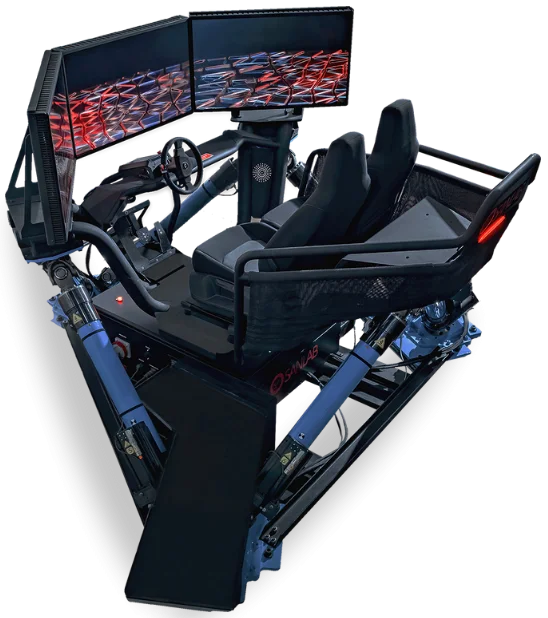
SM1800 DIL Simulator is a high-precision 6DOF simulation platform designed to deliver realistic multi-axis motion for vehicle testing and driver evaluation. Its advanced control system and modular design ensure adaptable configurations for simulation, prototyping, and training
|
|
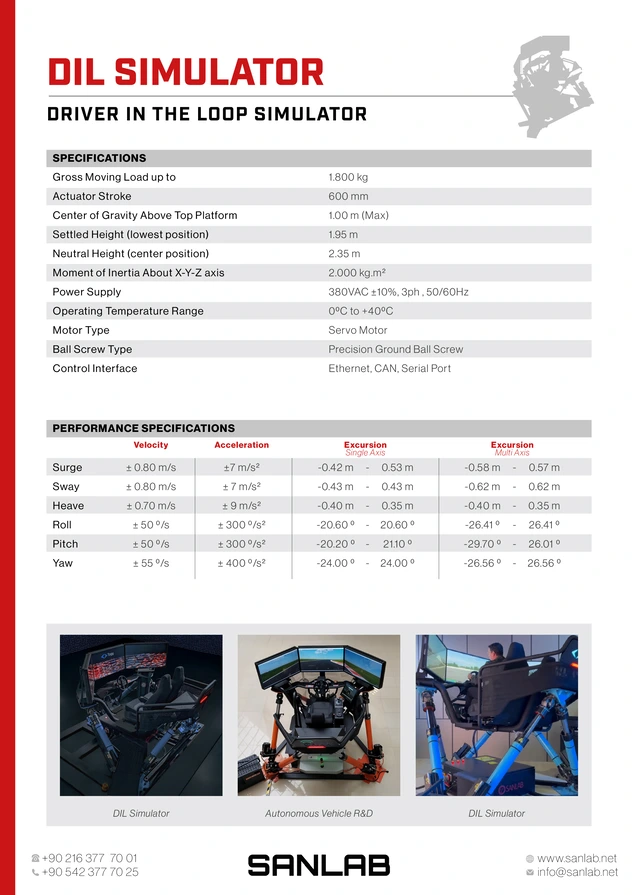
Velocity
|
Acceleration
|
|---|---|---|
|
Surge
|
± 0.80 m/s
|
± 7 m/s2
|
|
Sway
|
± 0.80 m/s
|
± 7 m/s2
|
|
Heave
|
± 0.70 m/s
|
± 9 m/s2
|
|
Roll
|
50°/s
|
± 300°/s²
|
|
Pitch
|
50°/s
|
± 300°/s²
|
|
Yaw
|
55°/s
|
± 400°/s²
|
Realistic motion cueing algorithm.
Hardware-in-the-loop (HIL) support.
Rapid prototyping integration.
High-fidelity motion control algorithms.
Modular & scalable system architecture.
High-fidelity motion control algorithms.
Real-time data capture & analysis.
Windows & Linux compatibility.
User session recording & export.
SM1800 DIL Simulator delivers precise 6DOF motion combined with an ergonomic driver cockpit. Its modular design and advanced control system ensure immersive simulation for testing, prototyping, and training in real-world driving scenarios
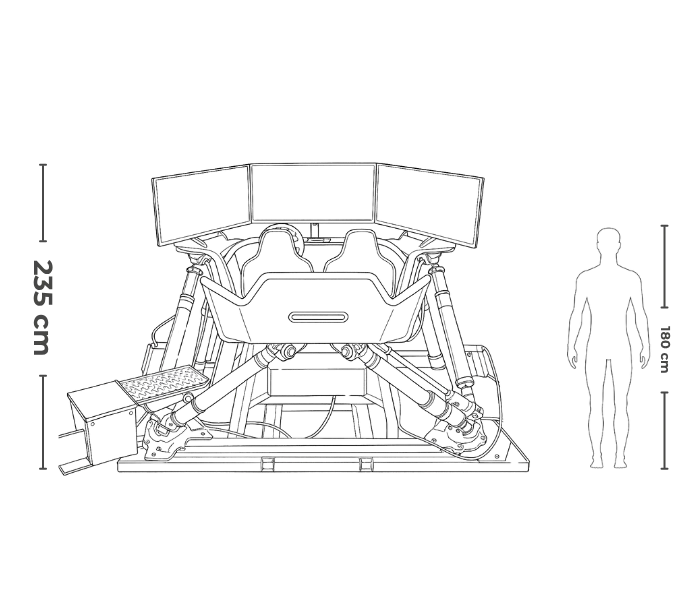
Allows for complex, multi-directional movement.
Real-time interaction for vehicle testing.
Hardware-in-the-loop and rapid prototyping.
Full compatibility via APO library.
Adjustable steering wheel & pedals.
Realistic driving feel with advanced algorithms.
A DIL simulator is a test system that closes the loop between a human driver and a simulated vehicle. The driver steers, brakes and accelerates, the real-time vehicle model computes the response, and the motion platform returns that response to the driver’s body as linear acceleration and angular movement.
The loop closes in a fixed order: driver input, vehicle model solution, motion and visual output, driver perception, then the next input. Because the human sits inside that order, the test captures how a driver actually reacts to a tuning change, not only how the model behaves on its own. SANLAB designs and builds 6DOF motion platforms, stabilizers and training simulators, and the SM1800 DIL Simulator uses its own 6DOF motion system. On the application side it sits with SANLAB’s automotive simulation applications, where motion is used to replicate driving dynamics and support vehicle validation.
Across the MIL, SIL and HIL chain, the object under test is the model, then the compiled software, then the real hardware. DIL adds the person. In common industry use, DIL is described as hardware-in-the-loop simulation combined with a driving simulator, so the controller and the driver are exercised at once.
The SM1800 product specification lists hardware-in-the-loop (HIL) support and rapid prototyping integration, so the simulator is designed to work alongside HIL test setups rather than standing apart from them.
The velocity and acceleration figures in the Performance Specifications table state how fast and how hard the platform can move on each axis. Everything the driver feels, braking, cornering, road input and body motion, has to fit inside those limits, so the table is the first place to check a planned maneuver.
| Axis | Specification | What the driver feels |
|---|---|---|
| Surge | ±0.80 m/s, ±7 m/s² | fore and aft acceleration through acceleration and braking |
| Sway | ±0.80 m/s, ±7 m/s² | lateral push in cornering and lane changes |
| Heave | ±0.70 m/s, ±9 m/s² | bumps, potholes and suspension travel |
| Roll | 50°/s, ±300°/s² | cornering lean and body roll |
| Pitch | 50°/s, ±300°/s² | nose dive under braking and squat under power |
| Yaw | 55°/s, ±400°/s² | the vehicle rotating about its own vertical axis |
No motion platform has unlimited travel, so sustained acceleration is produced by tilting the platform and using gravity, then returning it toward its start position slowly enough that the driver does not notice. The software layer that handles this trade is called motion cueing.
Two terms describe the mechanics. Tilt coordination is the tilt that stands in for a long acceleration the platform cannot travel through. Washout is the slow return to the neutral position, kept below the driver’s perception threshold. When a cue contradicts what the driver expects, it is called a false cue, and false cues are a recognized contributor to simulator sickness, which is why cueing setup matters as much as raw platform capability. The SM1800 specification lists a realistic motion cueing algorithm and high-fidelity motion control algorithms.
The SM1800 carries 1800 kg of payload and measures 350 cm in length, 310 cm in width and 235 cm in height. It combines its 6DOF motion with an ergonomic driver cockpit.
If you plan your own cockpit or cabin setup, count every item that rides on the platform:
Confirm your total mass budget, including driver weight, and the remaining margin for your configuration with SANLAB before you commit to a build. Request a quote with your intended cockpit mass and dimensions and the configuration can be checked against it.
The SM1800 DIL Simulator is fully compatible with IPG Truckmaker software via the APO library. Truckmaker is a vehicle dynamics environment for commercial vehicles, including tractor and trailer combinations, which makes the SM1800 a fit for teams working on trucks, tractor units and trailers.
Combined with the HIL support and rapid prototyping integration in the specification, that lets the vehicle’s control hardware and the driver meet in the same loop, which is the point of running testing and simulation systems with a person in the chain.
The SM1800 provides real-time data capture and analysis, plus user session recording and export, so a run can be reviewed after the driver leaves the seat. Sessions run under both Windows and Linux, and the system architecture is modular and scalable.
The driver interface side of the specification lists force feedback steering and pedals and a 5+1 audio system, so steering effort and sound arrive with the motion rather than after it.
It is a test system that puts a real driver inside the loop of a real-time vehicle model. The driver provides input, the model computes the vehicle response, and a motion platform returns that response physically, as acceleration and angular movement.
1800 kg. If you plan your own cockpit or cabin setup, build a mass budget from everything that rides on the platform: frame, seat, controls, rig-mounted displays, cabling and the driver. Confirm the total and the remaining margin for your configuration with SANLAB before building.
IPG Truckmaker, via the APO library, as listed in the SM1800 system specification.
Yes. The specification lists hardware-in-the-loop (HIL) support and rapid prototyping integration. For how it connects to your specific HIL rig, discuss the configuration with SANLAB.
The simulator measures 350 cm long, 310 cm wide and 235 cm high. For the clearance it needs while moving, ceiling height and installation requirements in your own room, ask SANLAB.
Specifying a DIL simulator comes down to three questions: what the platform has to carry, what it has to move inside your room, and what it has to talk to. Share your cockpit mass, available floor area and intended software setup, and the configuration can be reviewed against them. Contact SANLAB to start that conversation.